AI System
Previous: API Overview
Next: SLA System
The AI system supports intake and triage by classifying issue text and media, then storing the resulting prediction data with each request.
1) Runtime ownership
- Runtime inference and AI-integrated endpoints are in
smart-estate-backend. - Training and artifact generation are in
smart-estate-ai.
2) Runtime flow
Message and/or media input
  -> text analysis (chatbot.py)
  -> vision analysis (OpenAI Vision first, with local model support when available)
  -> fusion (fusion_engine.py)
  -> ticket updates + AI decision log persistence
  -> assignment + notifications
3) Implemented behavior
POST /api/chathandles AI-assisted intake and can create tickets.POST /api/upload-imagesupports media AI path.PATCH /api/ai/logs/{log_id}/feedbackrecords corrected categories.GET /api/ai/statusreports runtime AI availability.
4) Data captured
- Ticket-level AI result data (
ai_result). - AI decision records (
ai_logs) with predicted category, confidence, and feedback fields. - Metrics endpoint aggregates AI confidence and feedback coverage.
5) Runtime considerations
- Runtime quality depends on configured provider keys and available local artifacts.
- Tenant mobile AI interactions currently focus on guided intake workflows, while broader ticketing and chat capabilities are handled through existing backend-driven flows.
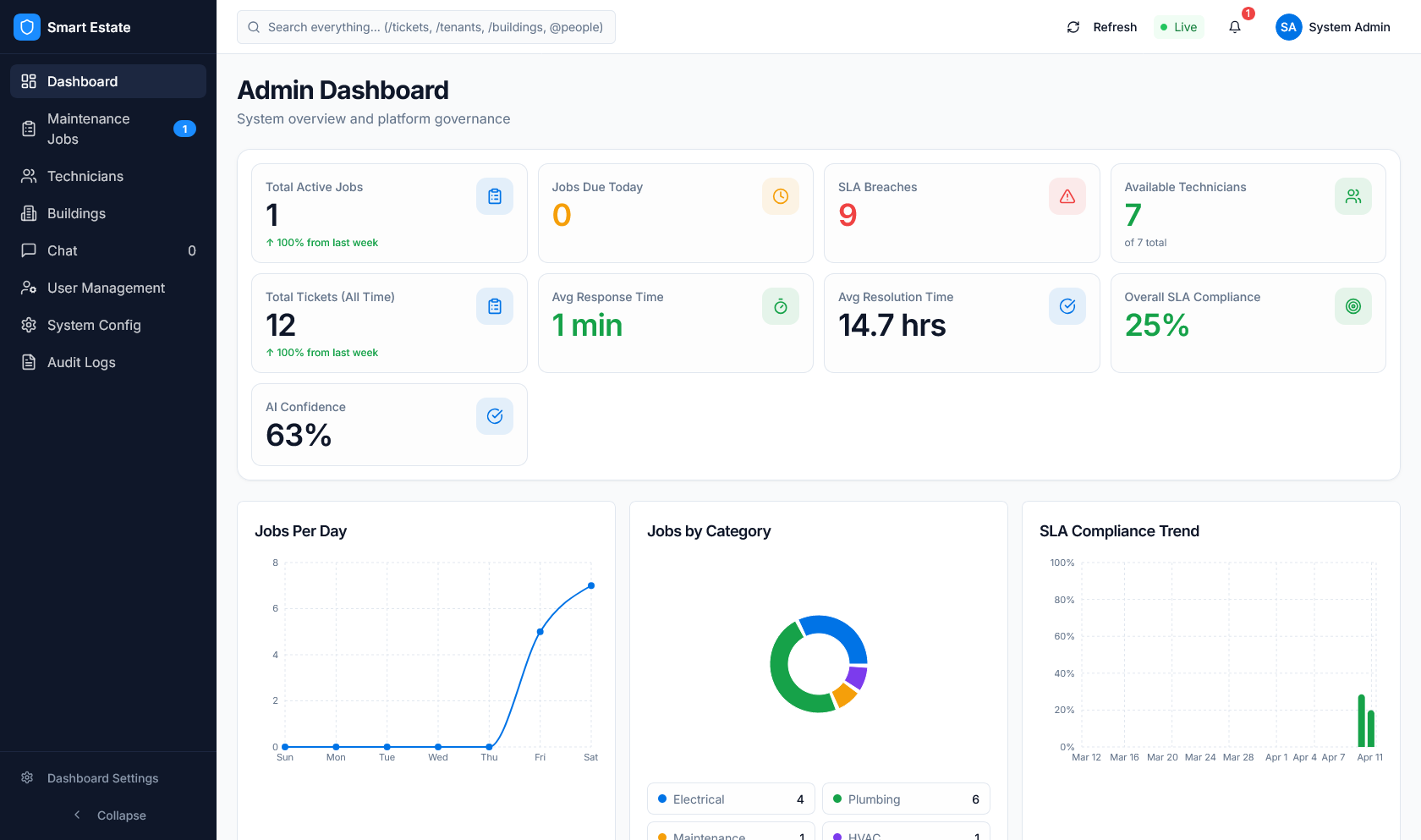 Caption: AI confidence is surfaced alongside ticket and SLA metrics in current dashboard UI.
Previous: API Overview
Next: SLA System