Architecture
Smart Estate uses a simple layered setup: React for the UI, FastAPI for business logic, PostgreSQL for storage, and modular AI services for ticket intake.
Why This Architecture
- FastAPI keeps the backend small, async, and easy to extend.
- PostgreSQL gives the system a reliable relational source of truth.
- React supports a live dashboard with fast operational feedback.
- AI modules stay modular, with fallback behavior when a model is unavailable.
Design Decisions
- Keep the backend as the source of truth for ticket and SLA state.
- Use PostgreSQL for durable relational records instead of scattered storage.
- Keep AI modules separate so text and vision can evolve independently.
- Favor dashboard refreshes and events over heavy client-side state.
Components
Backend
- Exposes auth, ticket, chat, SLA, AI, admin, and metrics endpoints.
- Owns validation, SLA calculation, assignment logic, and audit writes.
- Uses helper modules for dispatch, text classification, vision analysis, and fusion.
Dashboard
- Shows ticket queues, KPI cards, SLA state, chat, and system settings.
- Reads the backend through REST endpoints and live update events.
Database
- Stores users, tickets, buildings, apartments, SLA rules, AI logs, messages, media, and audit data.
- Keeps ticket lifecycle and SLA state consistent across the app.
AI Modules
- Text AI classifies the request and suggests priority.
- Vision AI reads uploaded media when present.
- Fusion logic combines both outputs into one ticket result.
System Diagram
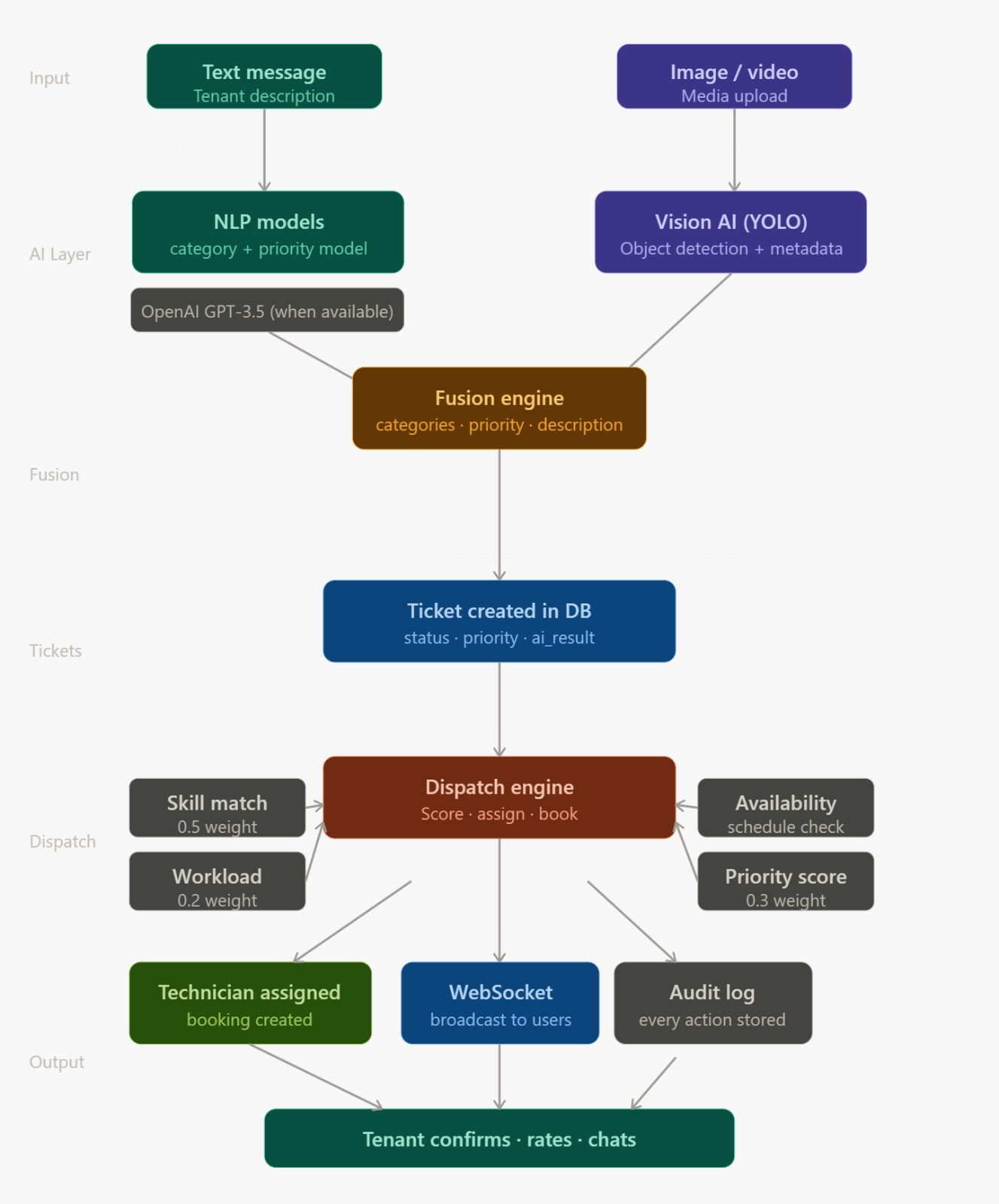 Caption: Backend, database, dashboard, and AI services working together in the implemented system.
How It Works
User action
  -> React dashboard or API call
  -> FastAPI business logic
  -> PostgreSQL read/write
  -> dashboard refresh and metrics update
Ticket intake
  -> text or media AI
  -> fusion engine
  -> ticket record + ai_logs
  -> SLA calculation + assignment